
World Forest Healing Forum | Alyx Francoise, FAO’s ‘Green City Initiative’
2025-10-29 Reporter Kim Bok-yeon
Alix Francoise, technical advisor of the United Nations Food and Agriculture Organization (FAO), points out health problems caused by rapid urbanization in the announcement of ‘Function of Urban Forests and Human Well-being’ and emphasizes that urban forests provide various social-environmental benefits such as temperature control, air quality improvement, and mental health improvement. However, it emphasizes policy priorities, civic participation, and international cooperation to address inequality, space constraints, and lack of management in urban forest accessibility. Through the ‘Green City Initiative’, the FAO aims to create a healthy and happy city by maximizing the potential of urban forests.

Alyx Francoise is the United Nations Food and Agriculture Organization’s (FAO) technical advisor on the Green City Initiative, which seeks to bring substantial improvements to the health and well-being of urban residents around the world by integrating urban and urban forest, agriculture, and circulating bioeconomics into urban living structures. Prior to that, he held a 15-year operational and research position at the French ̧aise de Dévelopment, a French public development financial institution, supporting the sustainable development of global southern hemisphere cities with an emphasis on ecosystem-based adaptation.
Urbanization Era, Urban Forests Are Important
In an increasingly urbanized world, the impact of urban forests on human health and well-being is growing. At the World Forest Healing Forum on Forest Therapy on the 28th, Alix Francoise, the U.N. Food and Agriculture Organization’s technical advisor on the Green City Initiative, delivered a keynote speech under the theme of “The Function of Urban Forests and Human Well-being: Insights for Maximizing Benefits,” suggesting the importance of urban forests and practical strategies for maximizing their benefits.
Surging urban population and urban health problems
Francoise stressed the rapid trend of urbanization, noting that the global urbanization rate increased from only 30% in 1950 to 54% in 2015 and is expected to reach 68% by 2050. He added that urban growth is progressing rapidly, especially in Asia and Africa and the Global South.
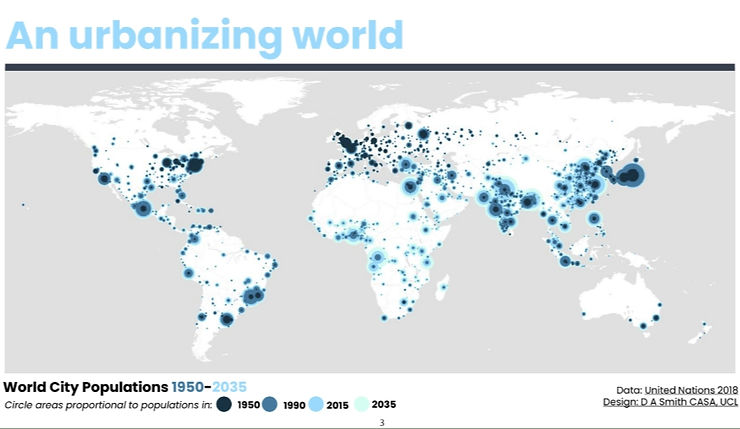
The global urbanization rate, which was only 30% in 1950, increased to 54% in 2015, is predicted to reach 68% by 2050. Photo by Alyx Francois
Francoise stressed the rapid trend of urbanization, noting that the global urbanization rate increased from only 30% in 1950 to 54% in 2015 and is expected to reach 68% by 2050. He added that urban growth is progressing rapidly, especially in Asia and Africa and the Global South.
The definition of urban forests and their various benefits
In 2016, the FAO issued guidelines for urban forests, which indicate that urban forests refer to networks or systems that include all forest groups, individual trees, and located in cities and surrounding areas. The Francoise Advisory explained that it encompasses various forms, including pocket parks, street trees, and rooftop greening, and is the backbone of urban green infrastructure and plays a role in bridging the gap between rural and urban areas.
Urban forests provide various benefits in social, economic, and environmental aspects. In particular, social-environmental benefits include both health and ecosystem benefits and are deeply interconnected. Urban forests also promote physical and mental health by controlling temperatures, relieving heat stress, improving air and water quality, and promoting biodiversity. In fact, trees have been shown to reduce urban temperatures by 2-8°C, alleviate urban heat island phenomena, improve mental health and worker productivity, and promote social interaction.
Unequal access and overcoming challenges
The Francoise Adviser pointed out that the benefits of these urban forests are very unequal distribution today. Citing the imbalance in green space coverage in African cities, he explained that inequality exists at the geographic level, the local level within cities, and the individual level. In particular, women tend to visit less natural and urban green spaces due to safety concerns, and a British study also highlighted the gender gap, noting that women feel three times more anxious than men in urban parks.
To overcome this inequality and maximize the benefits of urban forests for all, we presented the following four major challenges.
Space constraint: Urban forests are competing with other land-use priorities such as roads, infrastructure, and housing construction. To address this, it is important to adopt urban planning policies that prioritize green space, create various types of green spaces that fit the context such as pocket parks, micro forests, and vertical gardens, and utilize multifunctional land.
Urban Forest Management: Lack of skilled professionals and low awareness of urban forestry lead to inadequate maintenance. Solutions include training and certification systems for training professionals, civic engagement programs, and building urban forest inventory using digital tools such as 3D modeling, remote sensing, and satellite imagery.
Public awareness and participation: Low environmental awareness and lack of civic participation, conflicts among stakeholders, and lack of cooperation in the decision-making process are problematic. To overcome this, it is important to raise awareness and induce participation through tree planting events, educational programs, revitalization of the knowledge community and practice community, and holding regional and international forums.
Institutional and economic barriers: Urban forests have low priorities, lack of budget, and lack minimum standards on the policy agenda. It is necessary to set minimum standards, establish business cases by evaluating the value of urban forests and securing financial feasibility, integrate urban forestry in climate action plans, develop guidelines documents, and strengthen public-private cooperation.
FAO Green City Initiative and Future Prospects

Through the Green Cities Initiative launched in 2020, the FAO aims to improve the health and well-being of people in 1,000 cities by 2030. Photo by Alyx Francois
Francoise Adviser emphasized that urban forests have not yet become mainstream, and that long-term vision, multi-stakeholder engagement, cross-sector coordination, and above all, political will are needed. Through the Green Cities Initiative, launched in 2020, FAO aims to improve the health and well-being of people in 1,000 cities by 2030. This is done in a way that integrates the forest, agriculture, and bioeconomics of cities and surrounding cities into urban living structures.
The FAO is carrying out various activities such as projects in developing countries, knowledge sharing through web seminars, and publication of urban forest guidelines, and certifying cities that are striving to manage urban forests through the Tree Cities of the World program. Currently, 210 cities are participating in the program, and Korean cities have been encouraged to participate.
“Urban forests are not just green infrastructure, they are health infrastructure,” Francoise said, concluding the presentation by stressing that “interdisciplinary cooperation, multi-stakeholder coordination, and a mindset shift between authorities and all of us are needed to reach their full potential.” Reconstructing urban forests as the ‘backbone’ of urban and health infrastructure will be the key to creating a healthy and happy future city.
